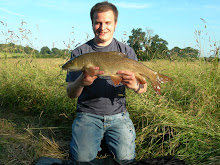
EVERYBODY knows that nature is dog-eat-dog world and last week I saw a startling reminder that beneath the water's surface fish are constantly fighting to keep their place in the food chain. It also proved that the chub must be amongst the toughest of fish that swim in our waters.
With a few hours on the bank in my sights last friday I headed for the river Whitewater on the Hampshire/Berkshire border. It was a lovely day as I made my way through fields towards the river, with the low winter sun in full blaze and fluffy, picture-book clouds scattered across a bright blue sky .
Normally on a short session, I'd go from swim to swim giving each about 20 minutes for a chub to make its presence known. Time was against me however, so I chose to sit it out in a favourite swim and wait for the sun to drop behind the trees and encourage the fish to feed.
Using a quiver tip with a light-ish running rig, I opened my rucksack to find I'd left the liquidised bread intended for the feeder at home. A quick re-think saw some micro pellets scalded in some hot water from my flask and a pellet cone sitting on top of my cheese paste hook bait, with a small lead replacing the feeder.
I duly cast in and sat back to enjoy the scenery and the sight of a buzzard circling over the field to my right. This particular bit of Whitewater is one of the most picturesque fisheries I've seen and it's always a pleasure to be there. Bites are simply a bonus at such a place, particularly when I had the entire stretch to myself.
A few casts later and an unmissable drop-back snapped me out of the trance induced by my surroundings. It was immediately followed up by some sharp pulls on the tip and I struck into a decent fish that quickly moved into the main flow of the river and out of the slack water where it had found my bait.
After a good scrap that gave away nothing of what I was about to discover, a chub surfaced with what I initially thought was a leaf stuck to its back. I netted it and closer inspection revealed that the fish was missing a large chunk of flesh leaving a cavity so deep that bone was visible.
As the photos show, this chub had had a very lucky and very recent escape from the jaws of death in the shape of what I reckon was a pike. You can see where it was grabbed from the U-shaped markings that start opposite the area where flesh had been removed and fit the shape of a pike's jaw.
I can't believe the fish was willing to feed so soon after being attacked. Not only will chub feed in the lowest of temperatures long after other species have switched off, it seems even a gaping wound won't deter them. Perhaps the low temperature of the water was keeping the wound numb and it appears that no organs were damaged. Hopefully the risk of infection will also be reduced by the cold water and this slightly lighter-than-usual four-pounder will live to fight another day.
No doubt the smell leaking from the wound will be particularly enticing to other predators hoping to pick off an easy meal but I'll still be looking out for a fish with a very recognisable scar next season.
Monday, 22 February 2010
Lucky escape for predator that became the prey
Labels:
Cheese paste,
Chub,
pellet cone,
pike,
river whitewater
Saturday, 20 February 2010
The Big One
I SPENT a good few hours eyeing up bargains at the Big One today and needless to say I ended up going home with a few.
For those of you who weren't there – though it seemed like most of the anglers in the country were – it's a huge tackle sale held in a hangar-like venue at Farnborough airport with hundreds of exhibitors selling gear at knock-down prices.
Lots of the sport's big names were there representing their various interests and it was good to see people like Steve Ringer and Keith Arthur chatting happily with the punters. It's often said that angling is the only sport where an amateur can compete alongside a world champion and there were certainly no barriers in evidence today.
There'll be more of the Big One from me at a later date but for now, I'm off to play with my new kit!
For those of you who weren't there – though it seemed like most of the anglers in the country were – it's a huge tackle sale held in a hangar-like venue at Farnborough airport with hundreds of exhibitors selling gear at knock-down prices.
Lots of the sport's big names were there representing their various interests and it was good to see people like Steve Ringer and Keith Arthur chatting happily with the punters. It's often said that angling is the only sport where an amateur can compete alongside a world champion and there were certainly no barriers in evidence today.
There'll be more of the Big One from me at a later date but for now, I'm off to play with my new kit!
Thursday, 18 February 2010
U-turn made as Trust joins calls for otter action
THE Angling Trust has finally made its stance on otters clear by joining many of the anglers it represents in demanding a sensible approach to controlling numbers of the fish killing predator.
Trust Chairman, Mike Heylin, has written to the Environment Agency, Natural England and the Department for Environment, Food and Rural Affairs to tell them just how serious a problem otter predation of fish stocks currently is and that regulations must be introduced to allow proper management of the species.
He told the Angling Times this week that the environment needs strict management not “loose regulation and poor legislation backed up by woolly-headed thinking,” and that Government regulations must make provision for the control of otters.
The Angling Trust launched a campaign strategy yesterday to highlight the concerns of anglers in this country in the run-up to the general election and it put otters firmly on the agenda. It has pledged to:
*Lobby Natural England to publicise the fact that it advises against the reintroduction of otters now that natural regeneration has been successful.
*Campaign for the protection and restoration of damaged river systems so that they can support healthier fish populations.
*Lobby the Environment Agency for more funds to be released to support the cost of fencing and other deterrents at still water fisheries to keep out otters.
Other points raised include pollution, overfishing, greater control of cormorants and more accountability of how rod licence money is spent.
A group of MPs chaired by Martin Salter (Lab) has also come together to act as Parliamentary Supporters of the Angling Trust. It will act as a link between the Angling Trust and Parliament to ensure that anglers' concerns on a variety of issues are heard by all the political parties before the election.
It has long been argued that with around three million anglers in this country, we are a body who cannot be ignored and whose views and votes really matter to politicians. For a long time however, this simply hasn't felt like the case.
But with six MPs in Parliament who share a vested interest in the sport and a governing body that seems finally to be firing on all cylinders, angling may just be starting to punch at its full fighting weight. It just remains to be seen whether it can land a blow that will knock the otter problem out for good.
See posts below for background to this story.
Trust Chairman, Mike Heylin, has written to the Environment Agency, Natural England and the Department for Environment, Food and Rural Affairs to tell them just how serious a problem otter predation of fish stocks currently is and that regulations must be introduced to allow proper management of the species.
He told the Angling Times this week that the environment needs strict management not “loose regulation and poor legislation backed up by woolly-headed thinking,” and that Government regulations must make provision for the control of otters.
The Angling Trust launched a campaign strategy yesterday to highlight the concerns of anglers in this country in the run-up to the general election and it put otters firmly on the agenda. It has pledged to:
*Lobby Natural England to publicise the fact that it advises against the reintroduction of otters now that natural regeneration has been successful.
*Campaign for the protection and restoration of damaged river systems so that they can support healthier fish populations.
*Lobby the Environment Agency for more funds to be released to support the cost of fencing and other deterrents at still water fisheries to keep out otters.
Other points raised include pollution, overfishing, greater control of cormorants and more accountability of how rod licence money is spent.
A group of MPs chaired by Martin Salter (Lab) has also come together to act as Parliamentary Supporters of the Angling Trust. It will act as a link between the Angling Trust and Parliament to ensure that anglers' concerns on a variety of issues are heard by all the political parties before the election.
It has long been argued that with around three million anglers in this country, we are a body who cannot be ignored and whose views and votes really matter to politicians. For a long time however, this simply hasn't felt like the case.
But with six MPs in Parliament who share a vested interest in the sport and a governing body that seems finally to be firing on all cylinders, angling may just be starting to punch at its full fighting weight. It just remains to be seen whether it can land a blow that will knock the otter problem out for good.
See posts below for background to this story.
Saturday, 13 February 2010
Angling Trust quick to distance itself from otter cull claims
AN unsubstantiated claim published on a newspaper website has got the Angling Trust (AT) up-in-arms over the issue of otter control.
“Angling Trust calls for cull of otters eating too much fish” screams the headline of an article published on timesonline.co.uk earlier this month.
The AT was quick to deny the claim and published a disclaimer on their website the same day demanding a retraction by the newspaper. At the time of writing, it's still there.
The article totally fails to back up what the headline claims which makes for a prime example of shoddy journalism and puts the paper in decidedly dodgy legal territory. It seems the writer – Simon de Bruxelles – has used it as an inflammatory hook to pull in readers before completely failing to acknowledge it throughout the article.
The Times also ran a printed version of the story – 'Who ate all the fish. The Otter, say Anglers' Wednesday, February 3 p.19, though it is slightly shorter than the electronic one and doesn't use the libelous headline.
In both articles the mention of a cull is not associated with the AT but with fishery owners who, de Bruxelles claims, are: “pressing the Government to allow a cull to keep [otter] numbers to manageable levels.”
Comments that have been left by readers of the web version are wide-ranging in their support for and criticism of the subject.
They include posts from 'Mark Castro', who has worked on the thorny issue of otters in the past with Chris Burt of the Angling Trust, himself quoted in the articles. More significantly, 'Michael Heylin', chairman of the organisation has left a lengthy reply to the story and both writers make a point of denying the AT's support for a cull of otters as the Times wrongly suggested.
On a media platform of this nature it's impossible to confirm whether or not the posts were written by the people they claim to be. It could have been any internet imposter but they toe the line already drawn by the AT.
Comments from unconfirmed sources floating in the realms of cyberspace isn't really the defining action I expect angling's governing body to take on the issue that is dominating the news pages of the angling press, and has now breached the pages of the national press.
If the AT is seriously concerned with what's been written – and it looks like there could be a case for libel – it needs to alert the Press Complaints Commission. It should be issuing an explanatory release to the angling press through which to convey its message to its members and it should have a thorough explanation on its website, not just a small panel displaying a few words alluding to the subject that can't be clicked on to access further information.
I'm yet to see any evidence of this happening and quite frankly, the matter isn't being handled in the professional manner that it and the sport of angling needs from its governing body.
Click here to read the article at timesonline and see the post below for my opinions on the subject.
“Angling Trust calls for cull of otters eating too much fish” screams the headline of an article published on timesonline.co.uk earlier this month.
The AT was quick to deny the claim and published a disclaimer on their website the same day demanding a retraction by the newspaper. At the time of writing, it's still there.
The article totally fails to back up what the headline claims which makes for a prime example of shoddy journalism and puts the paper in decidedly dodgy legal territory. It seems the writer – Simon de Bruxelles – has used it as an inflammatory hook to pull in readers before completely failing to acknowledge it throughout the article.
The Times also ran a printed version of the story – 'Who ate all the fish. The Otter, say Anglers' Wednesday, February 3 p.19, though it is slightly shorter than the electronic one and doesn't use the libelous headline.
In both articles the mention of a cull is not associated with the AT but with fishery owners who, de Bruxelles claims, are: “pressing the Government to allow a cull to keep [otter] numbers to manageable levels.”
Comments that have been left by readers of the web version are wide-ranging in their support for and criticism of the subject.
They include posts from 'Mark Castro', who has worked on the thorny issue of otters in the past with Chris Burt of the Angling Trust, himself quoted in the articles. More significantly, 'Michael Heylin', chairman of the organisation has left a lengthy reply to the story and both writers make a point of denying the AT's support for a cull of otters as the Times wrongly suggested.
On a media platform of this nature it's impossible to confirm whether or not the posts were written by the people they claim to be. It could have been any internet imposter but they toe the line already drawn by the AT.
Comments from unconfirmed sources floating in the realms of cyberspace isn't really the defining action I expect angling's governing body to take on the issue that is dominating the news pages of the angling press, and has now breached the pages of the national press.
If the AT is seriously concerned with what's been written – and it looks like there could be a case for libel – it needs to alert the Press Complaints Commission. It should be issuing an explanatory release to the angling press through which to convey its message to its members and it should have a thorough explanation on its website, not just a small panel displaying a few words alluding to the subject that can't be clicked on to access further information.
I'm yet to see any evidence of this happening and quite frankly, the matter isn't being handled in the professional manner that it and the sport of angling needs from its governing body.
Click here to read the article at timesonline and see the post below for my opinions on the subject.
The Otter Problem - My View
IT has recently become apparent that the otter is the latest threat to fish stocks, the livelihoods of people who depend on them as a source of income and the anglers who utilise them for sport.
They are currently decimating stocks of big fish in the way that cormorants have wiped out smaller species from some venues and when you add eastern Europeans into the mix, the picture start to look grim.
Many anglers would love to see the AT back a call for a sensible, well-researched, humanely carried out and ecologically sound otter cull. In fact if it did, the AT would probably receive a much needed boost in membership as a direct result.
On the other hand, to suggest culling what will forever be lodged in the nation's psyche as a “warm and cuddly” animal, as Chris Burt calls the public perception of the otter, would be a public relations disaster and serve only to widen the gap between anglers and some other waterways users and nature enthusiasts or 'antis'.
Regardless of how it occurs, something needs to be done about the otter problem that our sport now faces. More anglers joining the AT would help as it would provide a stronger, more united front with which to confront those who oppose the issue or even deny that a problem exists.
The Environment Agency (EA) needs to acknowledge the severity of the problem more seriously. Angling does not need its sympathy, it needs to see a return on the money that anglers fork out for a license each year to do something to prevent the unchecked rise of the otter.
An EA spokesman quoted in the Times suggests that: “where losses are particularly high, or are likely to be a serious problem, steps should be taken to prevent otters gaining access.”
The £100,000 that the EA has designated for otter-proof fencing is not going to cover the miles of river system yet to be subjected to the otter blight. To even begin to imagine that rivers and large lakes can be protected by expensive fencing is madness for too many reasons to list. It's simply not feasible which brings the argument back round to the need for a cull.
It has been pointed out that the otter's first choice from the piscatorial menu is the eel which is already in very real danger of extinction. This is incredibly worrying and for this reason alone the otter – a creature that belongs in the sea – needs to be kept under control so that we do not see the last of this ancient and mysterious fish disappear down Tarka's neck.
When eels have been wiped out and there aren't enough of the other freshwater species to sustain otter numbers, what will happen to them? Maybe they'll go into decline or be forced back to the sea and the problem will come to an end. But anglers will be left with nothing to fish for and a thriving British industry will be in tatters.
I have no doubt that my opinions on the matter are simplistic and I'm not pretending that they are fact or backed up by solid scientific evidence. Again, this is where I and thousands of other anglers need the AT and the EA to shed some proper light on the issue and take positive steps towards finding a solution, not just meekly pander to the whims of a public who simply don't understand the threat posed by the otter.
The article in the Times states that some unidentified 'experts' claim that coarse fishing could be wiped out in five years. While I don't think that this is currently the case, I'm concerned that it soon could be. To prevent it we must put our collective heads together and come up with a way to beat the cutest of enemies that the sport has ever faced in a way that suits all parties.
They are currently decimating stocks of big fish in the way that cormorants have wiped out smaller species from some venues and when you add eastern Europeans into the mix, the picture start to look grim.
Many anglers would love to see the AT back a call for a sensible, well-researched, humanely carried out and ecologically sound otter cull. In fact if it did, the AT would probably receive a much needed boost in membership as a direct result.
On the other hand, to suggest culling what will forever be lodged in the nation's psyche as a “warm and cuddly” animal, as Chris Burt calls the public perception of the otter, would be a public relations disaster and serve only to widen the gap between anglers and some other waterways users and nature enthusiasts or 'antis'.
Regardless of how it occurs, something needs to be done about the otter problem that our sport now faces. More anglers joining the AT would help as it would provide a stronger, more united front with which to confront those who oppose the issue or even deny that a problem exists.
The Environment Agency (EA) needs to acknowledge the severity of the problem more seriously. Angling does not need its sympathy, it needs to see a return on the money that anglers fork out for a license each year to do something to prevent the unchecked rise of the otter.
An EA spokesman quoted in the Times suggests that: “where losses are particularly high, or are likely to be a serious problem, steps should be taken to prevent otters gaining access.”
The £100,000 that the EA has designated for otter-proof fencing is not going to cover the miles of river system yet to be subjected to the otter blight. To even begin to imagine that rivers and large lakes can be protected by expensive fencing is madness for too many reasons to list. It's simply not feasible which brings the argument back round to the need for a cull.
It has been pointed out that the otter's first choice from the piscatorial menu is the eel which is already in very real danger of extinction. This is incredibly worrying and for this reason alone the otter – a creature that belongs in the sea – needs to be kept under control so that we do not see the last of this ancient and mysterious fish disappear down Tarka's neck.
When eels have been wiped out and there aren't enough of the other freshwater species to sustain otter numbers, what will happen to them? Maybe they'll go into decline or be forced back to the sea and the problem will come to an end. But anglers will be left with nothing to fish for and a thriving British industry will be in tatters.
I have no doubt that my opinions on the matter are simplistic and I'm not pretending that they are fact or backed up by solid scientific evidence. Again, this is where I and thousands of other anglers need the AT and the EA to shed some proper light on the issue and take positive steps towards finding a solution, not just meekly pander to the whims of a public who simply don't understand the threat posed by the otter.
The article in the Times states that some unidentified 'experts' claim that coarse fishing could be wiped out in five years. While I don't think that this is currently the case, I'm concerned that it soon could be. To prevent it we must put our collective heads together and come up with a way to beat the cutest of enemies that the sport has ever faced in a way that suits all parties.
Labels:
Angling Trust,
eels,
Environment Agency,
Otters,
rivers
Thursday, 28 January 2010
A smashing ton at Viaduct Fisheries?
WHEN ice becomes a factor in targeting lakes for a bite or two, my inclination is to head for the river. The chances of finding moving water frozen over are substantially less than that of still waters and to be honest, I'd almost certainly be at the river at this point in the season anyway.
But not every river holds a head of carp, whereas it seems that nearly every lake does, be it commercial fishery or club water. It also seems that this is the species for which the masses want to fish. Now, this is no revelation and it's been the case for what seems like forever, or at least since I became aware of trends within the sport.
I believe that it's this voracious appetite that anglers have for hauling carp which has fuelled the recent debate over whether ice should be smashed when fisheries become frozen, and indeed, has been the deciding factor when people have chosen to do so.
As a passionate angler, I want to wet a line as much as the next person, but when confronted by a frozen lake I just wouldn't bother to get my kit out of the car. If I wanted to go ice fishing, I'd go to Alaska and do it properly. Chances are, the fish aren't going to feed anyway, and call me naïve, but surely carp wouldn't be the obvious target species in freezing temperatures... would they?
Well apparently they would. News that bosses at Viaduct Fisheries in Somerset, spent two days smashing ice so that a match could go ahead came as a bit of a surprise to me. But it was a 100-peg event so I can understand that they didn't want to lose out on the revenue that it would generate.
But what was a real shock to me were the winning weights. A few pounds of roach right? Wrong. The top three anglers all breached the “magical ton barrier” with the winner putting together a 144lb bag. The story doesn't specify what species the fish were but my money is on that well documented winter feeder, the carp.
To me this is unnatural. How was it possible to catch so many carp so synonymous with lazy summer evenings and floating baits, from a lake where it took the preceding two days to smash the covering layer of ice?
This says two things to me. Firstly, the viewpoint that smashing ice is detrimental to fish stocks is blown clean out of the water. Clearly, it isn't.
Secondly, it speaks volumes about the fish in commercial fisheries. These carp must have become so conditioned to a regular feed-up of angler's baits that two days under ice must have been the equivalent of a heroin addict going cold turkey for them. When the bait started going in again they must have been only too relieved to get their hit as the dinner bell was sounded.
More worryingly, such a high stocking density means that the fish begin to get seriously hungry after two days under ice, as competition for what natural food exists is fierce, and they haven't had the slightest sniff of a pellet upon which they usually rely. So these fish need that bait and were queueing up to be hooked.
And that's really my beef with commercial fisheries. I'm not a biologist but if these were wild fish, surely they'd be lying up and conserving energy, avoiding predators and perhaps feeding sporadically, not consistently over five hours. When I go fishing, I want it to be an experience where I try to outwit a wily creature in it's natural habitat that is behaving in a way that has taken thousands of years of evolution to perfect, and yes, I often fail but that's all part of the game. What happened at Viaduct Fisheries is akin to feeding time at the zoo and I still can't quite get my head around it and the type of angling experience it represents.
But not every river holds a head of carp, whereas it seems that nearly every lake does, be it commercial fishery or club water. It also seems that this is the species for which the masses want to fish. Now, this is no revelation and it's been the case for what seems like forever, or at least since I became aware of trends within the sport.
I believe that it's this voracious appetite that anglers have for hauling carp which has fuelled the recent debate over whether ice should be smashed when fisheries become frozen, and indeed, has been the deciding factor when people have chosen to do so.
As a passionate angler, I want to wet a line as much as the next person, but when confronted by a frozen lake I just wouldn't bother to get my kit out of the car. If I wanted to go ice fishing, I'd go to Alaska and do it properly. Chances are, the fish aren't going to feed anyway, and call me naïve, but surely carp wouldn't be the obvious target species in freezing temperatures... would they?
Well apparently they would. News that bosses at Viaduct Fisheries in Somerset, spent two days smashing ice so that a match could go ahead came as a bit of a surprise to me. But it was a 100-peg event so I can understand that they didn't want to lose out on the revenue that it would generate.
But what was a real shock to me were the winning weights. A few pounds of roach right? Wrong. The top three anglers all breached the “magical ton barrier” with the winner putting together a 144lb bag. The story doesn't specify what species the fish were but my money is on that well documented winter feeder, the carp.
To me this is unnatural. How was it possible to catch so many carp so synonymous with lazy summer evenings and floating baits, from a lake where it took the preceding two days to smash the covering layer of ice?
This says two things to me. Firstly, the viewpoint that smashing ice is detrimental to fish stocks is blown clean out of the water. Clearly, it isn't.
Secondly, it speaks volumes about the fish in commercial fisheries. These carp must have become so conditioned to a regular feed-up of angler's baits that two days under ice must have been the equivalent of a heroin addict going cold turkey for them. When the bait started going in again they must have been only too relieved to get their hit as the dinner bell was sounded.
More worryingly, such a high stocking density means that the fish begin to get seriously hungry after two days under ice, as competition for what natural food exists is fierce, and they haven't had the slightest sniff of a pellet upon which they usually rely. So these fish need that bait and were queueing up to be hooked.
And that's really my beef with commercial fisheries. I'm not a biologist but if these were wild fish, surely they'd be lying up and conserving energy, avoiding predators and perhaps feeding sporadically, not consistently over five hours. When I go fishing, I want it to be an experience where I try to outwit a wily creature in it's natural habitat that is behaving in a way that has taken thousands of years of evolution to perfect, and yes, I often fail but that's all part of the game. What happened at Viaduct Fisheries is akin to feeding time at the zoo and I still can't quite get my head around it and the type of angling experience it represents.
Labels:
carp,
commercial fisheries,
ice,
roach,
viaduct fisheries
Chub rewards cold water efforts
LOADS of recent headlines and articles have been singing the praises of the chub as a species that will continue to feed, even with a lot of the country still firmly in the icy grip of winter.
My last three outings have all ended – though one of them didn't start – in pursuit of this greedy predator and after a couple of blanks, I finally connected with one of about 3lbs which was a most welcome sight after a good few fish-less hours on the frozen banks.
After lamenting the time I wasted at the Loddon in my last post on this blog, I took my own advice and headed a couple of days later to the river Blackwater. Conditions were indeed perfect though the fish disagreed as they stubbornly refused the cheese paste that I legered in all the likeliest-looking holes. Even into darkness they showed no interest but so angling goes...
Not entirely deterred, I returned yesterday and thought a size 20 hook tied to a 1lb 8oz link and baited with pinkies under a small stick float might winkle out a few dace and roach. It didn't. After flogging the swim for some hours with nothing to show but an aching arm for my efforts, I conceded defeat and put the float gear away.
There was just enough time left to give the leger a go and although the chub weren't playing ball last time, I reasoned that a slight rise in the air temperature might have encouraged them to feed. So with light fading fast I went to the most reliable swim on the river and was rewarded within a few casts with a big pair of rubbery lips slipping over the rim of my landing net, restoring my faith in my bait, tactics, tackle and ability!
My last three outings have all ended – though one of them didn't start – in pursuit of this greedy predator and after a couple of blanks, I finally connected with one of about 3lbs which was a most welcome sight after a good few fish-less hours on the frozen banks.
After lamenting the time I wasted at the Loddon in my last post on this blog, I took my own advice and headed a couple of days later to the river Blackwater. Conditions were indeed perfect though the fish disagreed as they stubbornly refused the cheese paste that I legered in all the likeliest-looking holes. Even into darkness they showed no interest but so angling goes...
Not entirely deterred, I returned yesterday and thought a size 20 hook tied to a 1lb 8oz link and baited with pinkies under a small stick float might winkle out a few dace and roach. It didn't. After flogging the swim for some hours with nothing to show but an aching arm for my efforts, I conceded defeat and put the float gear away.
There was just enough time left to give the leger a go and although the chub weren't playing ball last time, I reasoned that a slight rise in the air temperature might have encouraged them to feed. So with light fading fast I went to the most reliable swim on the river and was rewarded within a few casts with a big pair of rubbery lips slipping over the rim of my landing net, restoring my faith in my bait, tactics, tackle and ability!
Labels:
Cheese paste.,
Chub,
River Blackwater,
River Loddon
Subscribe to:
Posts (Atom)